Headless Marketing: A New Way of Working
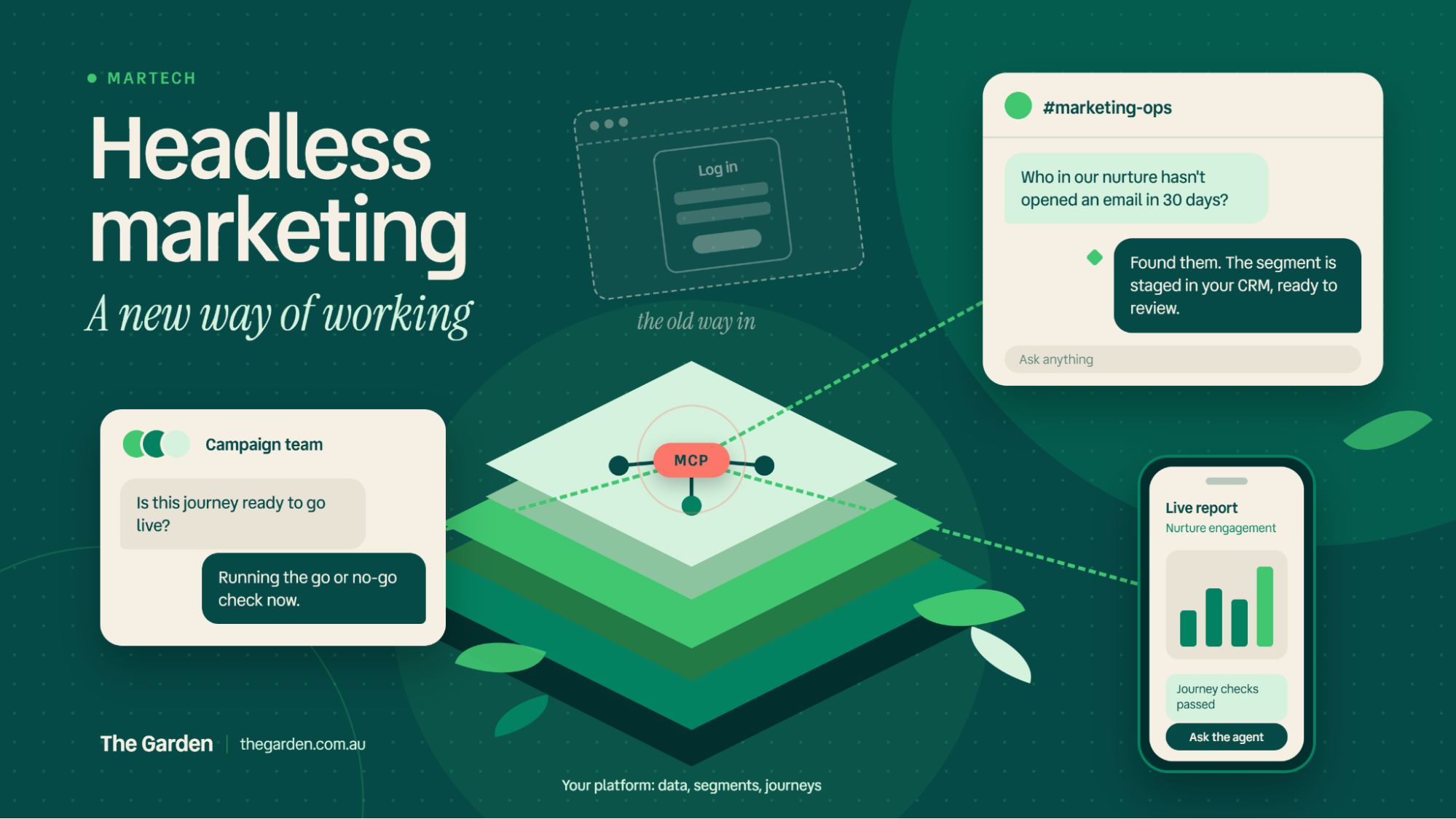
The way marketing teams work is changing. Instead of logging into a CRM, clicking through a journey builder and exporting a report, marketers are starting to ask for what they need in Slack or Claude: “Who in our nurture hasn’t opened an email in 30 days?” or “Is this journey ready to go live?”
This is headless marketing. The platforms stay where they are. The screen just stops being the only way in. For teams still running every task through a login, the cost adds up: one recent analysis of Salesforce’s Headless 360 counts 85 working hours, 10 handoffs and 8 weeks to ship a single enterprise email campaign.
Here’s what headless marketing actually means, and how your team can start using it without rebuilding your stack.
1. Decouple the engine: what headless marketing actually means
Headless marketing separates the engine of your marketing from the screen you use to run it, so your team can operate campaigns from Slack, Teams, Claude or a custom app instead of logging into each platform. The idea comes from headless commerce, where Adobe describes the storefront as the head and the operational engine as the body.
- The body. Your data, segments, journeys and business rules. This stays in your CRM or marketing automation platform, exactly as it is today.
- The head. The screen you use to operate it. It used to be the platform’s own interface. Now it can be wherever your team already works.
- The connector. APIs and the Model Context Protocol (MCP), a standard that lets AI tools find and trigger actions inside a platform.
- The agent. An AI assistant acting on your behalf. When it activates a segment, the change appears in the platform exactly as if you’d clicked the button yourself.
The Takeaway: Headless doesn’t replace your platform. It replaces the login.
2. Work where you already are: what headless looks like today
Headless marketing is already live in four places: campaign management, email production, content for AI search and audience segmentation. Salesforce made it mainstream in mid-2026 with Headless 360, which made its platform available to people and AI agents as APIs, MCP tools and command-line commands. HubSpot has opened up the same way. Its remote MCP server, generally available since April 2026, connects Claude, ChatGPT, Copilot and Gemini to HubSpot records, and every action follows the user’s existing HubSpot permissions. Its CMS works on the same principle: HubSpot’s own guide admits it isn’t strictly a headless CMS, but its CMS APIs let teams use Content Hub as one, so content built in HubSpot can appear on a site or app hosted elsewhere while staying connected to the CRM.
- Campaigns run from a conversation. You describe what you want in plain language, and an agent calls the right APIs in the right order and hands back the result. You can ask for a go or no-go check before a journey publishes, or find out who is getting too many emails, without opening a screen. In HubSpot, teams can now build campaigns and analyse revenue attribution straight from Claude.
- Email builds without the handoffs. An agent can find brand assets in a content system like Contentful and stage them, so nobody downloads and re-uploads images. It can read a Figma design and build the matching content blocks in Marketing Cloud, then write the personalisation logic from a plain-language request. HubSpot’s Nurture Agent, in public beta, personalises each nurture email with CRM data, engagement signals and live research.
- Content built for answer engines. Ahrefs calls this headless content marketing: pages written to be retrieved by AI search engines, not visited by people. They’re short and direct, full of specific facts, and updated constantly. The goal is being cited in the answer, not winning the click. As Ahrefs’ Ryan Law puts it: “Google already decapitated your search content.”
- One segment, every channel. Peak describes headless segmentation as audiences that aren’t tied to one system or channel. Build the segment once in the data layer, and email, push and your app all use the same definition. HubSpot makes the same case for content: manage it once and deliver it through APIs, and one source feeds the website, the app and every other channel. In WP Engine’s State of Headless 2024 report, cited by HubSpot, 80% of IT and marketing professionals said headless enables efficient content reuse across channels.
The same shift is happening in sales. With headless CRM, sellers ask Slack or Claude for account insights, deal updates and next steps instead of searching your CRM, and every action syncs back to the record.
The Takeaway: The work moves into the conversation. The platform keeps the record.
3. Know the trade-offs: where headless still needs people
Headless marketing removes the clicking, not the judgement. Someone still has to decide what good looks like, and the system is only as good as the data under it.
- Data comes first. Headless works best when real-time data powers your segments. Without it, you’re running campaigns on stale information, just faster.
- Check the agent’s work. Start with one prompt, run against a journey you already know well, so you can tell whether the answer is right.
- Scope the permissions. Headless actions run inside your existing governance, access controls and audit trails. Decide what an agent can read, what it can change, and what still needs a person to approve.
- Budget for set-up. Even Adobe’s own guide admits headless takes time and expertise to configure. A lighter MCP connection still needs an owner.
- Don’t bet everything on one search model. Ahrefs warns that headless content works because AI search leans heavily on pulling pages from an index, and that may not last. Treat machine-readable content as one layer, not a replacement for content people want to read.
4. Start small: moving from sandbox to production
The fastest way to start is to connect one AI assistant to one platform and prove it on work you already understand.
- List your clicks: find the friction. Write down the tasks your team does by hand every week, such as reporting pulls, list builds, journey checks and publishing. These are your first candidates.
- Check the foundations: data readiness. Look at your data before your tools. Clean, connected customer data is what makes any of this useful.
- Connect in a sandbox: read-only first. Start with a surface your team already lives in, like Slack, using an AI assistant your organisation has approved. Pair it with the MCP connection for your main platform, in a sandbox or with read-only access.
- Test, then go live: prove it on a journey you know. Run one prompt against a familiar journey and compare the agent’s answer with your own. Once it holds up, widen the scope and move it into production.
The Takeaway: Your first win doesn’t need a rebuild. It needs one prompt you can check.
Wrapping it up
At The Garden, we build and manage Marketing Operating Systems for high-consideration brands: one connected system running strategy, creative, media, MarTech and measurement together, instead of as separate channels. Headless marketing fits that model naturally. The system owns the logic, and the surface is wherever your team already works.
It changes content too. The pages that win citations in AI answers and the pages that convince a buyer making a big decision are increasingly different pages. A Marketing Operating System should run both from the same source of truth.
👉 Ready to see what headless could look like in your stack? Tell us where you’re at. We’ll show you what we’d build.
The latest.
Join our newsletter